Peptide Pureness & Quantitation Screening
페이지 정보

본문
Explore our directory to watch verified research compounds and learn more concerning our screening and quality assurance process.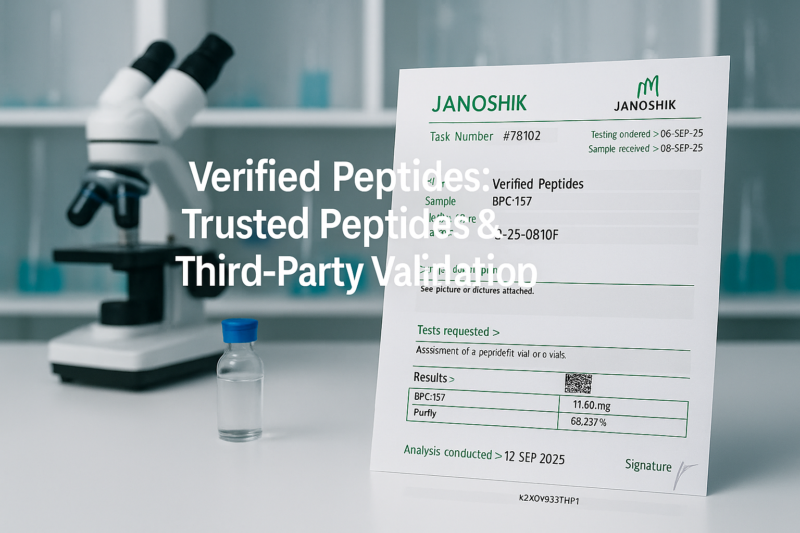 Even small impurities can alter results, decrease reproducibility, or present unwanted variables right into a research study. Scientists depend on precise, verified compounds to guarantee their searchings for are both valid and constant.
We sustain amino acid structure evaluation and internet peptide material assessment for groups that need more trusted focus setup and batch interpretation. HPLC-tested indicates the sample was gone through high-performance liquid chromatography to divide the target peptide from contaminations. The pureness percentage is usually determined from the main top location split by the complete incorporated peak location.
One of the most rigid grade, involving careful HPLC purification-- often multiple rounds-- and rigorous QC. Required for measurable researches, architectural biology, in vivo research study designs, and any kind of application where also small amounts of impurity could affect results. This is the quality where the boost most greatly, due to the fact that achieving that last 1-- 3% of pureness calls for discarding a significant fraction of the synthesized product. A deletion peptide missing out on a solitary residue could still bind to the very same receptor, however with different fondness or selectivity. In concentration-response experiments, these impurities can shift curves, flatten plateaus, or present biphasic behavior that obscures the true task of the target substance. The isoelectric factor (masterpiece) is an essential parameter for comprehending peptide solubility and behavior in numerous environments.
- Poor-quality peptides (those with unnoticed contaminations, incorrect series, or degraded parts) can result in misleading data and irreproducible outcomes.
- Simply put, rigorous lab recognition is how you confirm to regulators that your peptide meets all quality specs.
- Trusted peptide testing labs will offer a collection of modern-day logical methods-- HPLC combined with MS is a must, and schedule of added methods like capillary electrophoresis or amino acid analysis is a perk.
- In practical COA evaluation, the term usually refers to pureness screening, identity screening, and documentation review.
Imaginative Peptides proposes a collection of different purity degrees to aid you choose the right peptide purity for peptide-based assays and applications. The adhering to list reveals the recommended peptide pureness levels required for different peptide applications. Peptide recognition is largely done using mass spectrometry (MS), which provides accurate dimensions of peptide molecular weight. Additionally, techniques such as amino acid analysis and HPLC are utilized to verify the peptide's identity and pureness, guaranteeing accurate characterization for various applications. We provide peptide identity verification using mass-based techniques selected for the sample and analytical function. This is very important when the main inquiry is whether the observed component matches the desired peptide or whether a modification has been incorporated as expected.
How Does Lab Recognition Safeguard Against Peptide Fraud?
Importantly, this pureness number is usually identified after purification (e.g. by HPLC) and focuses on peptide pollutants-- it does not count recurring water, salts, or counter-ions in the dried peptide powder. In other words, the pureness portion is about the composition of peptide types in the example, not the weight payment of water or salts. A peptide could be 98% pure (suggesting really few peptide pollutants) yet still include some water or trifluoroacetate salt; those non-peptide elements would be reflected in the internet peptide material rather than the pureness percent. At Creative Peptides, we provide custom peptide chemical and physical evaluations for research study groups that need reliable information on peptide identity, pureness, composition, remedy habits, and example quality. Our service supports artificial, customized, cyclic, conjugated, and hard peptide examples with logical process constructed around the real project question as opposed to a fixed default panel.
Absence Of Organized Data Support For Launch Actions And Kinetics
Really few business research study peptide providers supply MS/MS data on routine COAs-- it is typically booked for pharmaceutical-grade materials and advanced study settings. Nonetheless, some costs providers do offer it on request for important batches. If sequence confirmation is vital for your study, this is the evaluation to request. It separates the elements of an example based on their differential fondness for a fixed stage (column packaging material) and a mobile stage (solvent system moving with the column). Peptides, with long molecular series and diverse conformations, present obstacles for structure confirmation and content decision. BOC Sciences leverages high-resolution mass spectrometry, LC-MS/MS, and NMR to precisely evaluate molecular structures and provide highly sensitive quantitative assistance.
A solitary generic chromatographic technique is frequently insufficient for peptides that are hydrophobic, extremely fundamental, carefully related in sequence, or partly purified. We supply HPLC and UPLC pureness analysis process that concentrate on helpful separation as opposed to only creating a portion. We make logical operations around the example kind, sequence functions, modification account, and choice context. Tasks may include unrefined intermediates, purified peptides, stored whole lots, client-supplied materials, or materials generated via our personalized peptide synthesis platform.
The friend page on why 99 percent purity issues discusses why tiny contamination percents can still matter in delicate in-vitro assays. Together with this peptide screening overview, those pages create the trust-methodology layer behind the product brochure. Peptide testing is effective, yet scientists ought to read the scope of each technique thoroughly.
Each peptide has actually a different expected molecular weight, so mass verification is not a common badge; it is compound-specific proof. For a deeper identity-focused description, see Mass Spectrometry Peptide Verification. Identity testing confirms that what was synthesised is actually the designated series.
Various other methods like electrophoresis, capillary electrophoresis (CE), and nuclear magnetic resonance (NMR) can likewise be used to examine peptide structure, fee, and purity, guaranteeing comprehensive characterization. In COA Testing review, it typically consists of HPLC pureness testing, mass spectrometry identity verification, and batch-specific documents revealing the tested great deal, approach, results, and day. For peptide purity screening, reverse-phase HPLC is the common conceptual design. The chromatographic pureness is then computed by contrasting the location under the primary optimal with the overall location under all incorporated peaks.
- 이전글Gambling Paradise 26.07.14
- 다음글Gambling Paradise 26.07.14
댓글목록
등록된 댓글이 없습니다.